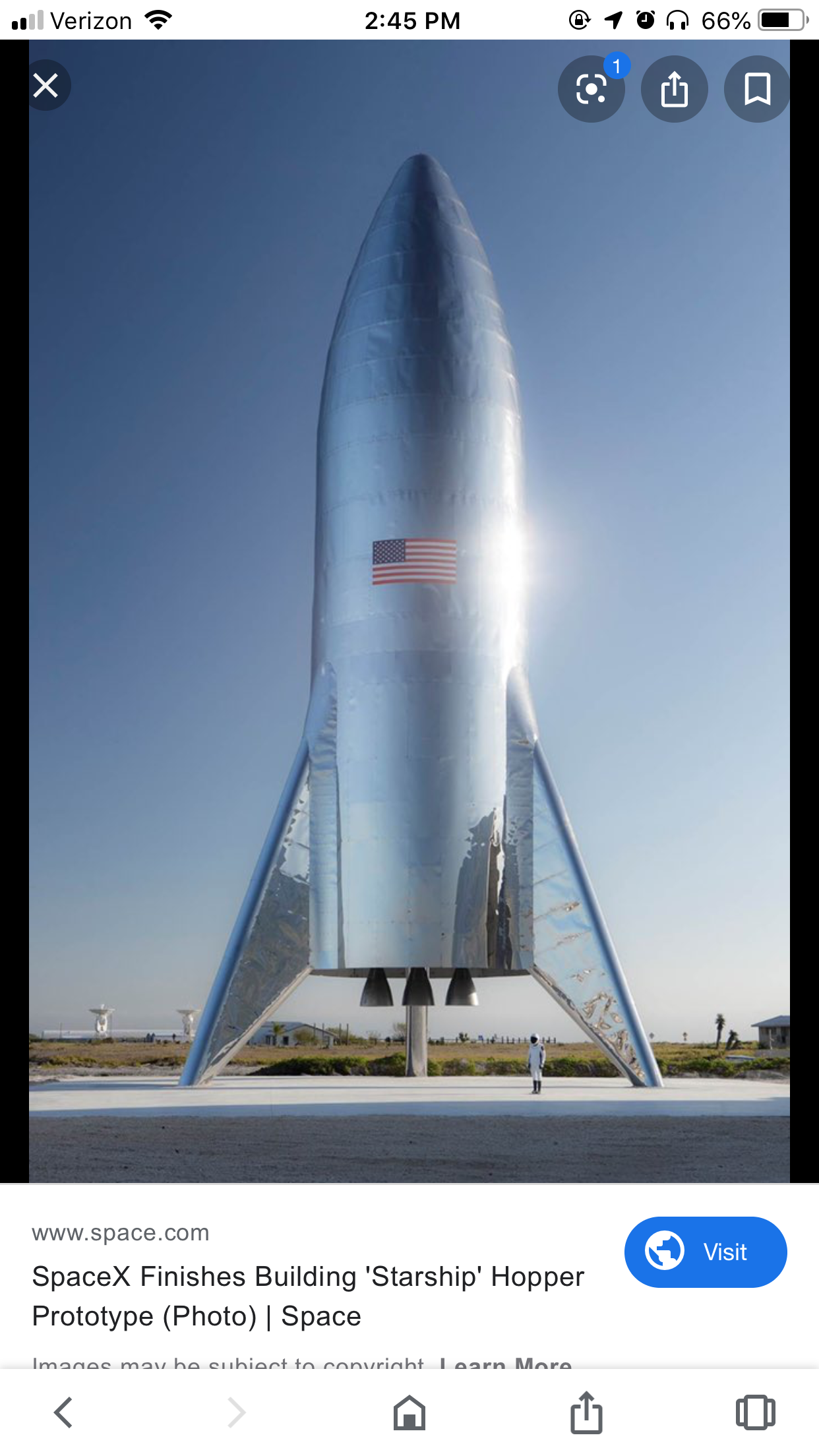
A larger version of this craft is expected to fly to the Moon and Mars sometime in the next few years.
I have written about my plan to colonize Mars in this blog but for this entry I will describe what I think Elon Musk’s SpaceX’s first mission to Mars should be.
The mission should
- Deposit 12 GPS satellites in orbit around Mars
- Refuel itself from methane refined from the surface of Mars
- Return to Earth with materials collected from Mars
- Deploy 4K VR rover that can provide humans on Earth a virtual view of Mars that will captivate the imagination of all humans.
- Deliver 3 more super rovers that will study the surface of the planet.
These are achievable goals for a first mission but are probably beyond SpaceX’s ability to deliver by itself.
This means my plan requires the participation of the US space agency.
The GPS Satellites
Today 24 GPS satellites circle the Earth providing everyone on Earth an ability to pinpoint their location within a meter.
A similar function is required on Mars to properly map and provide precise location of paths, resources and to annotate VR transmissions as well as support 24 hour a day high speed communications with Mars.
These satellites are an important part of my plan and I believe are essential to provide the robust communication and information needed for future activities on Mars.
Using these satellites any rocket will be able to land reliably on known safe spots. Rovers will be able to traverse and avoid obstacles and impediments. We will be able to precisely map locations of resources and know the precise position of everything and navigate.
These satellites should also provide the means to provide continuous hi-speed communication with the red planet and everything on it for anything that goes to Mars and possibly anywhere in the solar system.
Similar GPS satellites on Earth weigh about 2,000 lbs and so taking 12 will enable circling the red planet and for a weight of only 24,000 lbs.
There is probably a need for a ground station that might be brought along. This might be another 20,000 lbs.
Returning from Mars
Going to Mars will be impressive but 36 craft have gone to Mars. It will simply show basic capability. That is boring. Please don’t do this Elon if you are listening.
Returning from Mars will be transformative for NASA and the space program.
I can’t imagine that the feat of refueling a spacecraft on the surface of Mars and returning to Earth won’t signify a truly awe inspiring jump in Man’s abilities and accomplishment.
Having rocketship return to Earth and land possibly carrying Mars materials will be an event that culminates the most humans have ever dreamed of accomplishing and will make the idea we can actually go there and do things practical and seem real.
I believe that this will be so awe inspiring that Mars will become a huge interest for the whole world. It will make all the dreams of dreamers seem like they were real.
In order to do this rocketship will have to refuel from the surface of Mars.
You may not know this but all the plans for going to Mars have long anticipated that we would make methane on the surface and refuel. So this idea is not remarkable.
Rocketship was designed to use Methane as its fuel source for specifically this reason. The raptor engines Elon’s SpaceX developed are more powerful and efficient than the Merlin engines that power the current Falcon 9 rocket.
They also are optimized to operate in space and low oxygen atmospheres and are perfect for the journey. They also happen to utilize a fuel that can be easily manufactured on the moon or mars using basic building blocks we know are already there.
Interestingly we have found methane in the atmosphere of Mars which apparently is already being manufactured there somehow. Since methane would not last long in the atmosphere of Mars it must be continuously manufactured.
It is not known how this methane is being made but it is possible and maybe likely that some single cellular creatures are doing this. There has been a recent discovery that the amount of methane produced on Mars depends on the season.
There could still be a non-living source of this methane but scientists are not aware of what would do this or why on Mars without a biotic source.
Methane is a simple chemical that needs only co2 and hydrogen. Using a relatively easy method a combination of these chemicals in a simple reactor can produce pure methane.
Mars has enormous quantities of both co2 and water. There is enough water at the poles to cover the surface of Mars uniformly to a depth of 57 meters or 180 feet in depth.
Since the surface of Mars is quite rugged and varies in altitude by more than the difference between the lowest part of the deepest ocean trench and Mt Everest if all this water were melted it would create vast oceans and lakes. However since the surface temperature of Mars is too cold this water would all freeze as glaciers instantly.
The poles have huge amounts of water and co2 but they are also incredibly volatile. Most people are probably unaware that the poles of Mars every summer and winter go through dramatic changes that are extremely violent.
Winds of 400 mph and explosions of co2 vapor as glaciers melt and reconstitute during the seasons.
It is unlikely we could safely land or operate in close proximity to the poles which is why no one has tried to land craft yet near the poles.
Fortunately we believe there is both co2 and water all over Mars not just at the poles. We have seen lots of evidence from the surface movement we have observed that suggests that water is just under the surface in a lot of places.
Part of the scoping of the mission for the first mission to Mars will be finding a location to land that has a 100% probability of having the required materials easily available.
The 2020 rover may provide information useful for deciding on this critical location. The NASA 2020 rover mission will deliver a thermo-nuclear reactor powered rover ( similar to other craft we have deployed.)
The 2020 rover has the ability to last 30 years with this ultra reliable power source. It has tools to do microwave sounding into the crust of Mars to 500 foot depth letting us determine the density of material under the surface with high precision at various depths.
The 2020 rover can also look for life in a more robust way than previous craft and drill into the surface.
3 2020 Super-Rovers included
If I had my way I would include 3 of my super rovers I talk about in my plan.
These super rovers are an upgrade of the 2020 rovers.
Besides having 2 thermo power units per rover they would have enhanced speed, enhanced everything learned from the 2020 rover mission.
In addition these rovers would include the following:
4K VR enabled cameras
These cameras will connect to the GPS satellites circling Mars to transmit incredibly detailed virtual reality video back to Earth as they explore the surface of Mars.
The VR programs we can create for everyone on Earth to experience Mars will be incredible and life changing for people.
I believe these will transform interest in Mars.
A number of high explosives
During the history of mining on Earth it has been incredibly useful to blow up things. Blowing up things is extremely fun. It will make huge theater and excitement to Earth audiences but it also serves a very valuable function.
Explosions are the easiest way to remove massive amounts of material quickly that otherwise would require incredible amounts of labor that we don’t have on Mars.
Drilling on Mars will be problematic for a while. Therefore exploding the surface will be the most efficient way to dig and to mine as it has been on Earth.
I propose each rover include a dozen or so high explosives that can be deployed at interesting targets and detonated from a distance.
A central problem is finding a good chemical reaction that doesn’t depend on oxygen to explode. Almost all high explosives fit this bill.
Altogether the 2020 rover is 2500lbs. Including 3 Super Rovers describes above would be under 20,000 lbs and easily fit on the mission.
Producing Fuel
Producing fuel on Mars will require a reactor and power. The power can be supplied by the 6 thermo reactors ganged together to produce the energy needed.
Gathering the materials in chambers and then pumping it back into the rocketship. Ambient temperatures on Mars make this process efficient.
The co2 and water will have to be delivered in quantity for processing and possibly refined and separated. It will have to be warmed to react.
All of this is pretty well known but not tested. It is possible / likely that a prep mission prior to spaceships arrival might want to test this equipment.
The 2020 rover will demonstrate the production of oxygen from Mars surface materials. The success of this may be enough to have sufficient confidence in our ability to manufacture methane.
My guess is that the equipment needed to manufacture methane and store, pump and otherwise do this is somewhere in the 20,000 lb area.
The spaceship will not have to fill up to return to Earth.
Leaving Mars takes 1/30th the energy it takes to leave Earth due to Mars smaller gravity.
The trip back to Earth will involve the same delta V as getting to Mars but we will be helped by the fact that Earth is below Mars in the gravity well of the sun. Therefore we need less energy to return.
Further the mass of the ship will be far less after it disgorges all the cargo it has carried to Mars.
We will need to manufacture only a small fraction of the methane needed to get to Mars. Maybe 5% or 10% of the crafts capacity.
Collect stuff from Mars
While not that essential I think bringing back a good chunk of Martian soil will be a huge thing.
Once this soil is returned we can do things like test growing stuff in the soil. Do more extensive analysis for evidence of current or past life.
Try to create machines which can process and use it to create critical materials.
We can also try to create building materials out of the soil and test radiation protection properties of it to determine how much would be needed to provide protection for living things we eventually deliver to Mars.
For this reason I suggest we collect tons of raw soil and bring it back to the Earth. We will need something to collect this soil and store it on the journey. Possibly some inflatable or simple unfolded container and some kind of digger/scooper device.
Let’s say 20,000 pounds for all this too.
Returning to Earth
Returning to Earth is a critical element of this.
I hope that when we send people to Mars it is part of a colony that may never return.
Nevertheless the ability to return to Earth is a landmark ability that signifies that travel is practical and that commerce or some kind of sustainable path to creating a working colony on Mars is within reach.
I think that the return will be an enormously significant event in human history.
Summary
This mission I have described is incredibly exciting and I hope Elon sees the vision I am creating with this and feels the excitement as well.
It is practical to do everything I suggest for this first mission.
Developing the rovers and other technology is already on the roadmap of NASA or is simply an extension of things they are doing.
The time for this mission cannot be the 2020 window and probably can’t be ready for the 2022 timeframe. My guess is the earliest this mission could take place is the 2024/5 launch window.
Launches to Mars and for return are spaced approximately every 2 years due to the orbits of Earth and Mars. This means we have 4-5 years to get this all done.
The mission would take about 3 years because it would be 9 months there and then it would have to wait for the right return window and take near 9 months for the return.
It is possible there could be an expedited return if we can manufacture more fuel on Mars. In the best scenario with a full fuel load the return flight could take as little as 2 months.
I believe this mission would transform the human races path forward and could have an enormous impact on us from a species point of view. Possibly uniting people around the world in the possibilities of man actually becoming a space faring civilization.
Details:
GPS satellites = 24,000lbs, Ground Station = 20,000lbs, 3 4K super rovers = 20,000lbs, Reactor and processing for methane = 20,000 lbs, soil storage and collectors = 20,000lbs. This is only 100,000lbs well within the rocket’s lift capability of 240,000 lbs to Mars so this is a small amount of its payload capacity.
After this mission will be 3 Super Rovers on Mars with a 30 year lifespan sending Virtual Reality 4K images and mapping the surface of Mars collecting information on resources, paths to take to get from here to there. There will be a Methane production facility. There will be 12 GPS satellites that can be used to land future missions and act as high speed communication to Mars future missions as well as a relay for other deeper space missions.
Rovers will be blowing things up and exploring Mars at a scale 1,000 times more than current missions are.
We will have tons of Mars soil that can be used to experiment how easily it can be used for agricultural purposes, what it contains, much more ability to examine for past or current evidence of life, how it can be processed to do chemical engineering and used for building or other purposes.
The cost of this mission is probably $4 billion. However, a simple rover mission like the 2020 rover costs a billion dollars. This is 1,000 times more valuable.
 SpaceColonization
Leave a comment