Today America can’t launch a human into space. It is astonishing to realize this is true in spite of the fact the US led the space race and still does and that we went to the moon, the only nation to actually send humans there.
Yet, 50 years ago we were not only sending humans into space many times a year but all the way to the moon and back regularly. What is most astonishing to me is that we did this with technology which seems today to be ridiculously incapable of doing so.
In the last 50 years we have developed many new materials. We have uncovered much of the genetic fingerprint of life, we have raised the temperature of superconducting by 100 degrees and done incredible things in every aspect of science. We were idiots back in 1960s.
Most mind boggling is how computers have become so essential to everything and have grown in power. Virtually none of this existed in 1960s. Computers in the 60s were unbelievably primitive. They were slower than the slowest cell phone. They had less memory than the smallest cell phone. They computed at trillions of times slower speed than today. They were bulkier by millions of times.
The result is that putting any computer of serious capability on the Saturn and Apollo rocket was impossible. Way too unreliable and so everything on the Apollo was “analog” except for a few electronic switch like things.
Building a system composed of 6 million components that had to work together and in sequence flawlessly, to adjust to changes in conditions around them and do the right thing is unbelievable without computers. If you had asked me if building an Apollo was possible in 1960 (if we hadn’t done it) I would have had no hesitation in saying would be impossible.
Today people are taking enormous effort to build these systems just to get humans back into space reliably again even with all the experience and technology today.
Elon Musk’s rockets have computers in every part. Computers send telemetry back about everything and the computers adjust everything from angles of engines, flight surfaces, control the duration and strength of burns as well as send us pictures and video from all over the spacecraft. They had none of this in 1960s.
Fifty years ago we launched a 6 million pound analog machine composed of 6 million analog components into space with 3 human passengers and yet we were idiots by today’s technology.
Frankly it is not surprising that Apollo 13 happened and that they almost lost their lives. In fact, only 3 astronauts lost their lives until the 80s. These 3 all in a ground fire not in space. The idea that the rocket that Apollo 13 astronauts were in experienced an explosive event that caused the loss of almost all fuel and life support and yet they survived and came back to the earth even though they were 200,000 miles away from Earth is kind of unbelievable. It almost makes you want to say there must have been some divine intervention.
Of course, the reason they survived is because Apollo system had redundancies upon redundancies. When 2 of the 3 command modules batteries died and the command module had to be powered down it was fortunate that we carried an entirely separate spacecraft with us.
This might be a good lesson for travel to the moon and mars in the future. Make the spacecraft very reliable but carry a second spacecraft in case all your plans go awry.
The LEM (Lunar Excussion module) was designed to be completely independent because it had to go down to the moon’s surface and keep 2 people alive. So, utilizing it to become the new habitat was very convenient.
But the mission could and should have gone awry much sooner. As we have learned with numerous spacecraft single Apollo, the rubber tings between the sections of the spacecraft might freeze and leak. Small leaks from valves or tubing could cause explosions. Short circuits could happen easily. So many things could go wrong and without digital monitoring and control it all seems like impossible to build a machine reliable enough to do this to get into space let alone to the moon, land and return.
When people say they think it was faked: The moon landing. They are considered stupid. However, there is a certain amount of incredulity that we did it in such a short time with so few hiccups at such scale and so many times. 6 times we launched this system and it functioned more or less perfectly. Only once was there a serious mission threatening glitch and in spite of the severity of that glitch the humans survived. Unbelievable.
When I first saw the rocket booster of a Falcon 9 land on a pad I was frankly shocked. Elon’s idea of taking an unstable rocket booster and having it come back to a precise location and to land safely considering it’s weight and speeds involved seemed impossible. He seemed like an idiot to even try it. I seriously worried he was trying something that would never work.
The rocket boosters reach thousands of miles an hour. Traveling through the atmosphere at thousands of miles an hour generated massive heat. Even if something came back, would it be useful?
Everything is in the details. The first stage only reaches a few thousand miles an hour. The payload achieves most of its velocity gain when it has escaped the atmosphere and gravitational force of the Earth. So, the rocket ship doesn’t have to decrease from 25,000 miles per hour to zero. It is more like 2,000 miles per hour to zero.
This is not fast enough to generate the thousands of degrees of heat that the other parts will experience when they attempt to come back. Also, the air acts to help slow it down and innovative fins combined with GPS systems and computers at least give the reasonable chance that it can reach roughly the target.
The devil is in the details of how it can land so precisely and safely. The feeling seeing the Falcon 9 booster land is the same kind of feeling I have about the Apollo. It seems impossible. Yet there it is in front of you. It only took the courage to try it.
The Apollo Rocket is an impossibility by today’s thinking
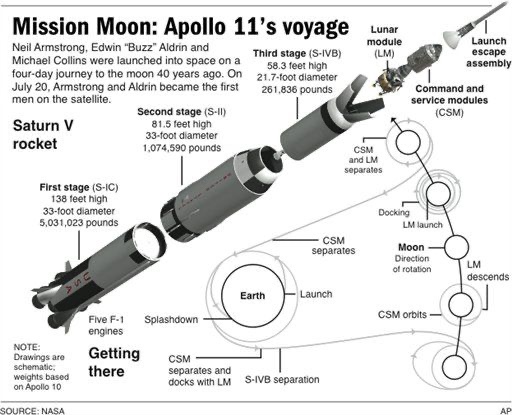
Such a thing without our digital age is unimaginable. Even more astonishing the US had only announced a desire to go to the moon 6 years earlier and had almost no experience launching rockets and what experience we had was really bad.
Rocket after rocket blew up on the launchpad or in mid-flight. America in 1963 wasn’t winning the space race. Russia was killing us and yet President Kennedy made an astonishingly absurd demand that we send people to the moon.
6 million analog components operating for 2 weeks without failure and with no digital system control is hard to imagine today.
3 human lives were on the line. Their existence dependent on the near perfect operation of these 6 million parts all without digital control.
We can’t build a car today without having 30 computers in them. Our homes have dozens of computers in them and we have become used to the idea you can’t build anything without some digital control. How could you build something that takes you to the moon and back and has no more compute power than is in my refrigerator today. It seems crazy and impossible.
The Apollo rocket is the most powerful rocket anyone has ever built. It generates 6 million pounds of thrust to lift this monster and getting it to a speed of 25,000 miles per hour or 40 times the speed of sound.
At any moment so much could go wrong catastrophically that it is hard not to believe some intervention of a diety must have been involved to make this work.
The Apollo consumes 40,000 pounds of highly volatile fuel per second. This fuel is the most explosive dangerous explosive liquid we could develop. It is held at ultra-low temperatures which if compromised would cause the material to become unstable. 90% of the mass of Saturn 5 is this explosive material.
This fuel is pumped through tubing and valves at high pressure to get 40,000 pounds of it to the bell shaped exhaust devices every second. The fuel is exploded on contact with the exhaust chambers producing millions of pounds of force that would eject a car of 5,000 lbs at over 1,000 miles per hour instantly if it was in the path.
The path of the thrust has to be precise and equal between the 5 engines. Minor variations of one percent in the thrust or direction would cause the rocket to veer off course and crash killing everyone. So, these things not only have to work but they have to work nearly identically across all 5 rockets simultaneously or catastrophe would result. Remember this was not computer controlled.
The Apollo launch consists of 3 stages. The first is massive but as soon as the fuel runs out there must be a seamless transition to a second stage with the ejection of the first stage and igniting the second stage.
All of this had to be performed essentially with systems that were more or less operating without “intelligence.” They had to assume everything operates perfectly. If there is any variation or failure things would just go catastrophically wrong because everything else would operate without a clue.
Following that the second stage running out of fuel then leads to the third stage which has to eject the second stage and start itself. This has to be done automatically because the physical pressure on the astronauts during launch can be as high as 10G’s, i.e. each astronaut will weigh 2,000 pounds at times and will be unable to reliably operate machinery and may be on the edge of consciousness.
Of course this same dynamic stress of 10G’s is felt by the entire rocket and all the components. If any of the 6 million parts breaks during this period of 10G stress probably puts the lives of the humans in danger.
Without digital control it wouldn’t be likely the astronauts would even know something went wrong. Apollo 13 suffered from this problem. They did see signs of failures but they had no understanding of what went wrong. They saw that the oxygen had escaped because they had analog gauges. These gauges were wired so when they got below a certain level lights would go on but they had no inkling what had gone wrong in the parts that caused this.
The danger of the engines is probably one percent of the things that could go wrong in the flight of apollo.
Inside the Apollo missions and 6 million parts. An infinite number of possible failures.
The vast majority of 6 million components of the Apollo rocket are not in the rockets themselves. The Apollo mission consists of 5 major sub-assemblies. 3 of these are the 3 stages of rockets. The other 2 consist of the command module and the LEM (Lunar Excursion module)
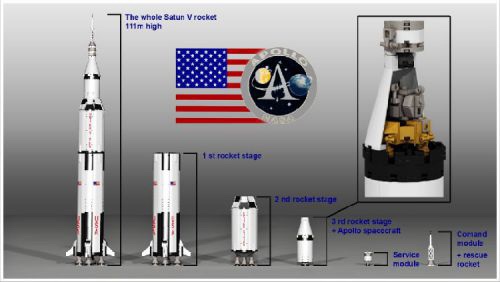
After Apollo managed to get into orbit around the Earth the mission was really about to start. A complex set of maneuvers needed to be completed to get the spacecraft ready to go to the moon.
The components were not pre-assembled in position because it was too big and the wrong shape to fit into the top of the rocket.
After insertion into orbit the Apollo commanders had to manually turn the command module around, connect it to the service module (rocket for the trip to the moon and back) and to the LEM, a gangly spider like assembly. These things had to be “docked” which was a new thing we had very little experience with.
The LEM and Command Module were each barely big enough to hold the people in them. There was no room to spare. There was barely room for 2 people in the LEM and 3 in the command module. Unlike the ISS which is about 4,000 sq ft of space for 7 people or 600 sq ft per person the command module and LEM had a total of about twice the physical size occupied by the passengers themselves. For 10 – 14 days they had to live in this space.
Once the assembly of the service module attached to the command module docked to the top of the LEM could then be accelerated another 10,000 miles per hour to get to escape velocity of the Earth’s gravitational hold.
The trip to the moon is short. It is only 250,000 miles away. Considering the assembly will be going 35,000 miles/hour leaving the Earth you might think it’s only 8 hours to the moon. Less than a trip to London from San Francisco.
Of course the gravity of the Earth pulls on the assembly slowing it down to 3,000 miles per hour eventually so that it takes 3 days to get to the moon and 3 days back. If you spend a couple days at the moon or a week your total trip time will be somewhere between 9-14 days.
You need to depend on these 5 million remaining components to function pretty much without fail during this 10 days or so.
The systems of the LEM and the command module need to keep human beings alive and safe from the instantly deadly conditions just outside the thin walls of the machine they are canned up in.
This includes air, water, food, temperature, waste products must be sustained. You can’t take enough of these things for the whole trip so you need to recycle them as much as possible so their are systems which clean the air and reuse it, the same with water and waste. The abilities to do this in Apollo were not nearly what we do today.
Besides the life sustaining functions, the Command module and LEM must have navigation, have their own rockets, their own communications systems, compute systems (more like hand held calculator) and cameras as well as safety systems, medical supplies.
They also have a reaction control system which allows them to orient and control the rotation of the spacecraft and to maneuver them.
Computer Technology is the most changed
We had steel, maybe not carbon fiber or pica. We had methane but even today methane is still among the best rocket fuels.
What we didn’t have is computer power like today. The law called Moore’s law was not even known then. Over the 50 years since 1960s every year we have seen a 50% increase in speed, density and power.
I asked an IBM engineer in the 1970s what the most density we could achieve for computers. He told me 64,000 bits for a chip about 1/4 inch on a side. He told me that was not only the possible limit they were shooting for but that any density higher than that was theoretically impossible.
That chip cost thousands of dollars. Today we mass produce for a dollar chips with 6,400,000,000,000 bits and it is 25% of the size of the chip back then. That’s more than billions of times smaller and cheaper. It is also billions of times faster. It was beyond our imagination back then to think we could place trillions of transistors in a space smaller than your pinkies fingernail and it would work.
One of the other miracles of today’s electronics is the bandwidth of cellular phones. Today’s cellular phones are capable of 10s of millions of bits per second transmission and reception over the air.
Back in the 80s we were told that the maximum transmission rate of data was limited by something called the nyquist rule. This rule was a theoretical limit not one that we had achieved but it said that we could only transmit data at most 1/2 the frequency we modulated it with.
It was hard to get hundreds of bits per second to go through the atmosphere back then. Millions per second sounds like science fiction back then. We were told effectively it would be impossible and certainly would require massive antennae and huge power. You wouldn’t be able to hold it in your hand.
Your cell phone is evidence of astonishing accomplishment that defies explanation at times. While no one could have put together such a thing in one step incremental improvements in thousands of technologies over decades produced the ability to do what seems impossible.
We didn’t have any of this back in 1960s
If we had known what was possible we might have given up and said, let’s do this later when we have better technology. Fortunately, nobody even imagined the technology of today so they weren’t encumbered by what we can do today and feel helpless at the complexity of the problem they were trying to solve.
Consider the type of digital electronics we had at the time were unreliable slow and limited. I remember that calculators I had at the time were so slow that you could actually see the calculators compute a multiplication. Today, computers perform trillions of calculations that are trillion times the ability of one calculation back then.
Computers back then could do calculations to 10 digits precision while we typically do 20 digits of precision. As a result these calculators could do things like help the astronauts compute the duration of a rocket engine fire but it was utterly incapable say to actually run the engine.
So, saying there were computers on the Apollo but this was closer in functionality to the cup holder for your cell phone today. They weren’t integrated really into the systems. The computers didn’t control more than a few actuators and they weren’t aware of anything on the machines they were in. That data would have to be fed into the calculators manually to compute what they needed.
There was also no GPS. Frequently the calculations of location, time of burn, strength of the burn were approximate. They had to be acquired from the ground who used telescopes to verify their calculations. The accuracy required to get to the moon was hard but it is the path back that has to be really precise. We didn’t care that much where we landed on the moon but for the Earth you needed a very precise trajectory to get a safe insertion.
If you miss the Earth by even 1% you might be unable to get into the correct orbit and fail to return to the surface even though you could get all the way back. You had to be able to orient the spacecraft within less than 0.2%. An error any greater could cause the Apollo command module to bounce off the atmosphere and skirt into space to be lost forever or to come in too steep and burn up killing all on board.
Similarly the lunar module (LEM) had enough fuel to spend a couple minutes to land the LEM. They had almost no extra fuel. Assuming the rockets work on the LEM Apollo 11 had only 25 seconds of fuel left before they would have had to abort and try to return to the command module.
At the Moon
When the gangly assembly of millions of analog components gets to the moon the 2 main components of the LEM and Command Module had to be disassembled.
They didn’t have a single “thing” that could land on the moon, launch itself back up and go back to the Earth in one system. This is because it was too heavy. So, they had a separate craft to go to the moon and launch from the moon.
The LEM had the advantage that since it didn’t have to take the pressure of Earth’s atmosphere or the dynamic pressures associated with landing on the Earth going through an atmosphere or the heat so it could be built extremely thin.
The walls of the LEM were literally paper thin. This is one of the things I find amazing. If one of the astronauts had simply made a small kick of their foot accidentally wrongly they could easily have totally destroyed and pierced the wall of the LEM killing the passengers.
The LEM in later missions took with it things such as rovers the astronauts drove around on the surface of the moon for longer trips and all kinds of test equipment and experiments. The lander was also expected to take back hundreds of pounds of rocks from the surface of the moon.
The LEM itself was broken into 2 pieces one was the rocket that landed the LEM on the surface. A second rocket was used to lift off from the moon leaving the first rocket on the surface.
Each of these sub assemblies of course have to work perfectly even though we have no way of controlling them or knowing if they are working. This includes systems which provide atmosphere and other life giving supplies as well as heating, navigating and provide communications.
Much of the rockets systems was controllable from the Earth. The ground had the ability to monitor the astonauts physical conditions and also they got digitized versions of the various gauges and they could turn systems off and on. They couldn’t control the flight or the engines but they had some limited control and visibility into the systems analog features like fuel levels and air pressure levels.
Since there was no computer control the command module continued circling the moon staffed by one of the astronauts as the other 2 went to the surface.
The gravity of the moon is 1/6th the Earth’s. This made the fuel and forces to land and take off from the moon about 1% of what was needed for taking off from the Earth. When you need less fuel you need less mass which means that the weight of the whole system can be reduced dramatically but you still need the same reliability of everything even though these are different systems.
How does Quantum Mechanics fit into all this?
One of the things that should astound you is that there are metals that are hard enough and have high enough temperature of melting and that there are fuels with such explosive capacity.
Why do such things even exist? It is easy to imagine a world where the variety of chemicals and different prosperities of those chemicals when combined didn’t vary so much.
By taking two relatively inert chemicals and combining them you can produce something of astonishing volatility. On the other hand you can take two or more chemicals of various properties and out of the blue make a chemical that produces the softest materials and materials with cleaning power.
How is it that we can produce so many chemicals that have profound effects on virus’s and bacteria but not harm the host?
The astonishing maleability of nature is a wonder. Why? Well,an obvious answer is that since humans exist and consist of 100,000 different cells most of which we acquire from the external world to produce humans there had to be incredible ability of nature to produce variety of properties.
This is the anthropomorphic explanation. Since we require incredibly complex chemical properties to exist and we exist therefore there is tremendous complexity in the chemicals.
However, a world without this complexity might be more probable but then we wouldn’t exist so the question is moot. Nonetheless, we are astonished that we even exist. It is almost as if the universe were created with such complexity so we could be here to discover it.
I have some articles on why everything exists, why the universe is as it is and what our role is in it. This article is just more evidence of the incredible nature of quantum mechanics to create possible variation that facilitates amazing almost miraculous things.
What the limit of such variety of materials and properties is unknown. We have already found materials that exhibit superconductivity at almost room temperature.
Superconductivity is almost an impossible thing. What it does is allow electrons to flow in perpetuity to create perpetual fields and what seems impossible work at 0 cost. Superconductivity for instance would allow us to transmit power around the US at 0 loss.
Another use of supercondictivity related to space is that the European Union was able to create a material that could support supercondictivity that created a magnetic field sufficient to repel dangerous radiation on a spacecraft for a trip to Mars.
Such a material distributed as a ring around an area would create a perpetual magnetic field that would make safe travel in space without a lot of power required.
What is not there yet?
In spite of the fact we have learned a lot we are still at the beginning of discovering how this complexity of the world that is enabled by the fact that quantum mechanics exists.
We know the plant takes a single photon from the sun and is able to funnel that small energy to split a Co2 molecule and some sugar molecules to support life. This is 1,000,000 times more efficient than we can do this with classical chemical reactions. We are at the beginning of understanding how to leverage quantum mechanics to do things that seem like miracles to our eyes at this scale we perceive things.
Quantum computers leverage aspects of quantum mechanics to potentially solve problems infinitely faster (literally) than today’s computers. So, we are hardly at the end of miracles.
If you find yourself becoming pessimistic or depressed. Think about this. The potential for us to find solutions to our problems is very great. Sometimes we can solve them simply by having the guts to try.
Apollo and Elon Musk’s Falcon 9 landings and even the Tesla is examples how technologies may exist today without any significant fundamental discoveries that just take someone with enough gumption to take the effort to try.
Summary
The failure of life support, rocket systems and a myriad of components would kill the astronauts. The number of failure scenarios is millions. Without some digital system to monitor all these things and cut stuff off automatically, adjust the operation, reduce the usage of resources when they are less needed it is hard to imagine how you could build a working system that had any reliability.
It is really astonishing how good we got at building these analog systems and how reliable we could make them.
There were wires. Things were still controlled frequently by dumb analog systems. Valves designed to self-regulate pressure and adjust to changes in pressure but they still used wires to turn off and on various systems. There were 15 miles of wire.
We think wires are reliable at least. However, a short in the wires to one of the reaction control systems on Apollo 13 which caused a fire and blowout of one of the oxygen tanks.
The fire not only caused an explosion of the reaction control system and an uncontrolled rotation of the Apollo 13 command module and LEM but also depleted a huge portion of their oxygen supply.
I won’t explain how the Apollo 13 astronauts recovered from this failure and made it safely back to Earth. That is explained in the movie Apollo 13 with Tom Hanks that is easily one of the most amazing movies ever made. I highly recommend seeing this movie. The launch and re-entry scenes are incredible.
The remarkable thing is that the US built this system in 6 years from the date that President Kennedy called for it and that we ran 7 successful missions to Mars using this system without the use of a single computer on the Apollo itself besides the navigation calculator.
Where we are today
What is depressing about this story is that after 50 years since the launch of Apollo 13, the most ill fated of the Apollo missions the United States today lacks the ability to launch a human into space.
We depend on Russian Soyuz rockets developed in the 1990s to launch humans. The retiring of the Shuttle fleet and the lack of plans to develop an alternate system or resurrect any of the prior systems has left the US bereft of human launch capability for 15 years or twice as long as it took to develop the Apollo in the 1960s.
You may wonder why we seem so stupid now. How could something that we did so easily it seems back then take so long and be so problematic now?
First we were spending 1/10th as much as today as a percentage of GDP back in the 60s. But spending is only a part of it. We have lacked direction. Why build a manned capability? We also have very high requirements for the new system. We were willing to take risks that we aren’t willing to do today.
An important thing I believe is that we reduce the cost of bring a pound of mass into space. I have said this many times in my blogs on space and our missions to Mars.
The cost of anything you do in space is multiplied by the cost to lift a pound into space. The Space Shuttle cost $2 billion/mission. It could take a 1/4 million pounds into space. That is $4 thousand per pound. If you build a space station or do a mission that weights 1 million pounds pounds then you have a cost of $4 billion.
Elon Musk’s SpaceX took on the goal of reducing this cost to space. SpaceX today can deliver a pound into space at $500/pound or less. With their reusable components the cost could drop to $100/pound maybe even less.
While cost/pound may not be an important factor when you are delivering human beings the whole point of having humans in space is so they can do things. The equipment and things we can do depend on this cost.
For instance, it cost $100 billion to build the ISS space station now orbiting the Earth using the space shuttle. Today we might be able to build a space station 10 times bigger for the same cost.
If you want to do missions to Mars and do things in space then the cost to go to space has to be the first priority. Fortunately, Elon Musk has taken on this task and we all should thank him for doing something that NASA has not been able to do.
The Shuttle was supposed to be reusable but the technology and vision at the time did not achieve that. The Shuttle actually turned out more expensive than any other way to lift mass into space. It was too complex and not enough was truly reusable.
NASA started 2 contracts with private companies to build manned systems. One is being built by Boeing and the other by SpaceX. These 2 new rockets and craft will be flying with humans sometime early this year. Possibly very soon.
The 2 new manned craft are dramatically better than the Soyuz and the Apollo or even the Shuttle. The Elon Musk “Crew Dragon” can hold 7 people unlike Soyuz and Apollo which can hold 3 each.
They are spacious in comparison and have numerous safety features that virtually eliminate the risks hopefully. That has yet to be proved but Elon’s craft can separate from an exploding rocket beneath the passengers and take them away safely from even a catastrophic explosion that has happened during previous missions. This was tested late last year.
The inside of a Crew Dragon is much like riding in a Tesla. SpaceX reuses the same monitors you will find in your Tesla if you own one. Other components are shared between the Tesla and SpaceX’s rockets.
As if Elon Musk and SpaceX didn’t have enough on their hands they are also building a second manned ship called “Spaceship.” This craft is a gleaming stainless steel marvel of engineering that Elon hopes to scale up to be a craft to go to Mars.
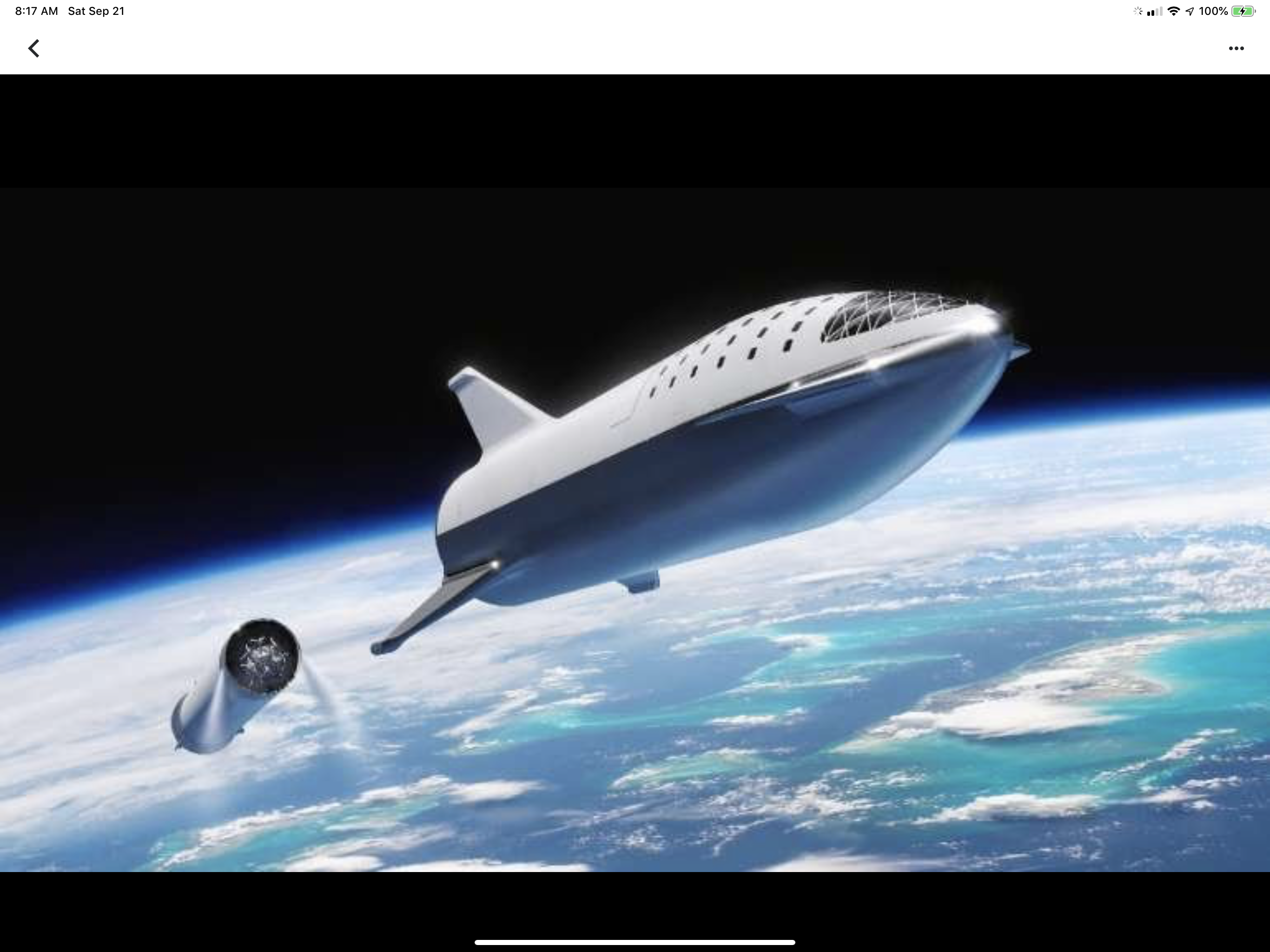
The “Spaceship” borrows lessons from its other rockets to be reusable 100%. It is also designed to use methane fuel which can be manufactured on the surface of Mars easily so Spaceship can refuel on Mars or the moon using fuel made locally.
Spaceship is a marvel partly because it is being designed to not use the “pica” material used in almost all other returning spaceships from space.
Pica is expensive heat ablating material that wears off and substantially increased the cost of the shuttle missions because the failure of PICa and replacement of it drastically increased the cost of the Shuttle missions over what the planners anticipated.
Spaceship uses steel a material that is not high tech. Steel has amazing properties including high melting temperature and durability. Elon’s Spaceship has a liquid cooling system under the most heated parts of the Spaceship on reentry. Elon has calculated that this is feasible and drastically increases the reusability and the cost of the Spaceship.
What I’m saying is that while we are slow getting back into space we are on the verge of some truly amazing things. I expect this year the launch of Americans into space will be a major event that will have a major effect on the psyche of a nation under tremendous stress right now.
I believe that this movement of America into manned travel again will be a big jumpstart for people’s psyche. It could be like in the 60s how the mission to the moon lifted America’s sprits and gave the world a hope for a different future.
The reason why this is worth doing is because we want to eventually go to Mars. I think we could have a new space program that could be one of the engines to drive the economy forward again.
I believe it should be a goal of the US to go to Mars. The pandemic could be used facetiously to argue that having a place where humans live that are ultimately “social-distanced” was one of the reasons Elon has used for going to Mars.
Elon has stated that this “second home” for humans is his reason. I think its a valid reason but its not enough.
This is actually valid long term but I won’t engage in fear mongering. It is possible that a much worse pandemic could strike the world and having some humans isolated away on Mars is one way to assure continuity. But I don’t believe that is the reason to justify going to Mars.
I believe we should go to Mars and colonize because we are the only known intelligence in the universe. We owe it to ourselves to spread ourselves to show we are capable of doing this and to eventually be a greater species.
If we had an alien come to Earth and we had to tell them how advanced we were the answer of the most impressive thing man has ever done is go to the moon.
We pulled together our technology to deliver our bodies to another planet. There is simply nothing humans have ever done that compares. If you disagree tell me.
Have humans hit their peak? Is that it? We went to the moon 7 times and then withdrew? That’s it? We are capable of doing more. We can go to Mars. Doing it is essential for us to advance, to move to being a multi-planet species would be an incredible achievement.
To do that and make it sustainable is the key not simply to go there like we did with the moon. Going to mars just to pick up some rocks would be a waste of money. We don’t need Mars rocks and it proves almost nothing.
We can build a colony on Mars that bootstraps humanity that is self-sustaining eventually. I have documented the path in these blogs. Elon Musk has a similar vision with a different path but that is not important. What is important is that we can set this as a goal and it can drive a new optimism in the US and the world to give the world a reason to work together, to have aspirations and dreams.
Some will say a dream of making everybody safe and healthy in the world would be a better goal. There is no reason not to have both goals and it could very well be that working to achieve one helps the other.
Let’s take this opportunity of the first flight of humans by American rocket this year as the opportunity to renew American optimism and can do spirit to drive a new phase of space travel eventually to establish a colony on Mars.
 SpaceColonization
Leave a comment