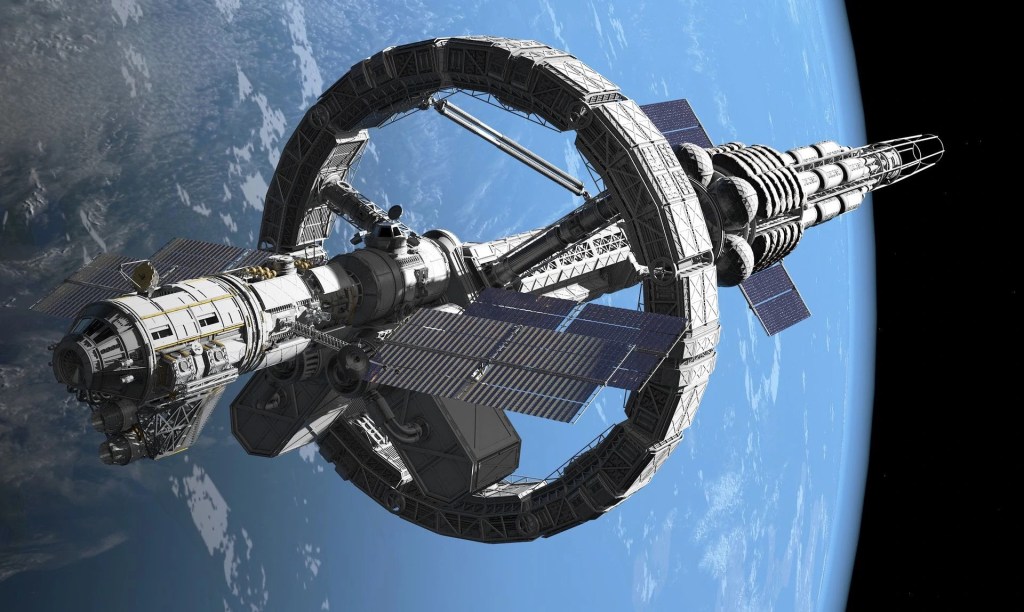
We need to expand our vision of what we want to do in space. The current plan of NASA is far greater than any other nations and it is virtually nothing. NASA plans to go to the moon again in 2025.
The US space budget is $25 billion (including military components) which does exceed every other country by a huge amount but we get very little for this $25 billion and we have gotten very little.
This is about to change or it could change.
Elon Musk and SpaceX have built a workhorse that cuts the cost to do space missions by a factor of at least 10 if not 100. The Starship will become a reality in 2024 and it will allow hundreds of space missions where we do 1 or 10 today.
SpaceX plans to use it to launch 40,000 Starlink satellites which will blanket the Earth in continuous high speed internet anywhere on the Earth. This alone will generate many billions in revenue for SpaceX on top of its growing dominance of the liftoff market SpaceX will become more and more a near monopoly of space transportation.
With liftoff costs cheaper than any competitor by a factor of 2 or 3 (and with SpaceX able to make massive profit on each mission) besides the ability to lift more mass than any other craft plus a giant capacity to lift objects up to 100 feet in length and 30 feet in width it can lift virtually anything we want.
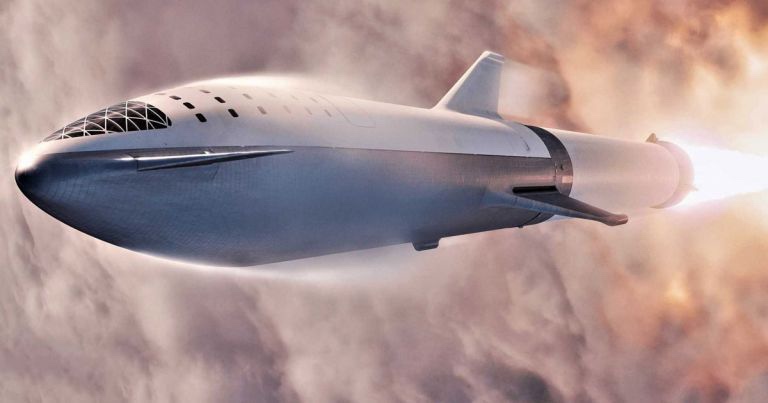
Starship also has the ability to return to Earth, be retrofitted and resupplied and take off again within hour. That is a nicety. A day will do. Bit I understand Elon’s thinking behind why he wants to achieve it. It’s about making this into something as reusable as an airplane so the costs become more like an airplane.
He wants to get costs down below $100M a flight. Down closer to $10M a flight. Whether he can achieve it with Starship is not important. It’s already such a massive reduction that the world has changed.
Starships really revolutionary capability is to be refueled in space and to land on planets, refuel on the planet and take off from them by itself. It is a one-stop shop for anything you want to do and for 1/10th to 1/100th the cost of todays lift vehicles.
All of this is why I say we must imagine more. We must scale up our plans for space because we will waste an incredibly opportunity to take advantage of a massive change in the space equation that has limited missions in the past.
In the past we were limited to 1,000-2,000 lbs for any “payload” that went to another planet. Because of the high energy required to get out of Low Earth Orbit (LEO) to Geostationary (GSO) or to escape velocity to leave Earth the amount of mass that could be delivered beyond was severely limited even if you wanted to spend a lot of money.
With Starship we can deliver massive experiments and craft that can weight 150,000 lbs to go to planets or asteroids or anything we dream.
The question is what do we dream?
Clearly one dream is to eventually colonize the moon or Mars. Those are truly big efforts that will require moving 10 million lbs and will take hundreds of Starship missions and decades to achieve.
We can plan missions to the other planets and asteroids. We have to expand our horizons of what is possible. To me this is like the chip revolution. When chip costs fall they enable new applications.
Our future is to go to space. Why deny it? Why delay it? Stop thinking like Scrooge. Elon has made a lot of money building his dream. If he succeeds with Starship it can spawn industries that America can lead and new technologies and take our minds off stupid issues like racism and did you wear your mask. Get over it. Start thinking big.
We can do something nearly as impressive as a colony on Mars at least in a much shorter term, which is a new space station that could be a focus of missions in the future.
A spaceship is only part of the story. If all we do is go to mars maybe we don’t need a super space station. (SSS)
A space station
The current space station at 4,000 sqft in space is pathetic and can only support half a dozen people. It has limited possibilities and its limitations means it is essentially useless. Yet we spend $4 billion a year maintaining it.
For years I’ve thought we should either throw it away or give it to Elon and SpaceX with a stipend to keep it operational but it’s a huge waste of money. Now I have the answer. We build a replacement and either find a way to leverage the existing station as an add-on (might as well add it to the SSS.
The cost of this ISS monstrosity has held back NASA from other plans in space. It is like a lead weight on us. I propose instead of trying to make the ISS useful we build another much more capable and dream filled station so big it will be ridiculous in comparison.
Everyone has dreamed someday we would have a space station to build larger missions because we can’t lift off from Earth giant things like space stations or interplanetary craft or other equipment we might need to support serious exploration on these other planets, moons and asteroids.
A space station is a not 100% necessary but very useful thing to have that will be a focus more and more as we do things from there cheaper and far easier than here on Earth because of the difficulty of taking everything with you.
Because of Starship we can do preparation to go to Mars and by the time we do that we can have half or more of the space station built. We can do them both.
The current approach of space is to launch a rocket that has everything you will ever need on that mission. That becomes impractical and drastically limits what kinds of missions you can do and how fast.
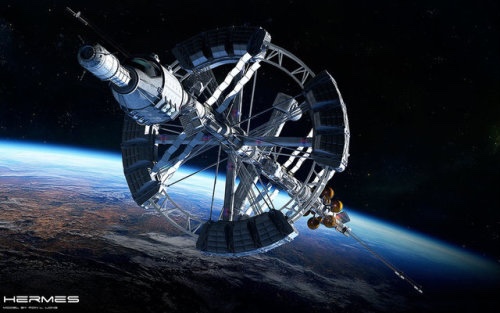
A space station of larger size that rotates has always been a dream as much as colonization of other planets and it is achievable at much lower cost and time.
So, what would a space station do?
The current space station is able to do limited experiments. It was supposed to give us world peace. Not sure that worked.
The ISS is not robust enough to build things and it is too small to assemble anything or to do much with or store anything. All my plans to use the ISS were a total retrofit. Forget that. In the past we’ve had trouble even staffing it because of lack of US lift capability.
That’s all changed.
A space station like I propose could do the following:
- Much more impressive and important experiments
- Actual experience in a partial gravity environment
- Store fuel and supplies for loading onto ships to go deeper into space
- Assemble multiple ships or units together to form more “space” appropriate transport that uses other propulsion systems.
- Space Tourism
- Depot for resupply and maintenance for other space based satellites, ships, stations or bases.
- Alternative propulsion ships built and launched (nuclear, ion)
- Rescue missions and repair missions faster and easier to deploy
- Possible military uses (not big on this)
- Who knows?
A larger space station would enable a much bigger vision and plans for space and to do so at far less cost.
Rotation and Size key factors

When I wrote the article on the Starship I got more and more excited and interested in the design of this space station we could build. The key features of my space station is its rotation and size.
Rotation is needed to produce gravity. Gravity means longer term endurance for people.
A key feature to determining the gravity we could generate is the radius of the station. The bigger the radius the more gravity can be created with minimal side effects on the mammals that reside on the station.
My first instinct was to build it small to make it very cost effective. I proposed a 500ft radius that could be built I estimate for $10 -$20 billion. Compared to the $150 billion for the current ISS it is remarkable how easy it is for us to do this compared to what we had before. This is because Starship makes delivery of mass so much cheaper.
Even this small scale station would be 20 times the 4000 sqft size of the existing station and 10 times the mass. But it would be doable in less than $10 billion I believe.
Just consider for one second that the democrats were proposing bills for $4 trillion that funded things like $500 million to tear down racist statues.
In the current NASA budget the reductions SpaceX could achieve for current space station budget would be enough savings to pay for building a new space station like this.
A 2600 ft radius or one mile in length one side to the other
However, as I thought about it and did more design work I realized that if we built a larger radius it allows us to generate more gravity with less rotational naseau.
We don’t have to finish the station all at once. In other words we could build for the same $10 billion a space station with a 2,500 foot radius but build only 1/4 or 1/8th the outside shell.
If fully completed you could run a 10K race on the space station going around it in two traversals.
As time and need arose we could deliver new modules to expand the space station to its full capability which would eventually could support 500 or more people.
So, the station could have a large radius of rotation and be built out over time till its full size is realized as needed. It could still be cheap to build the first version because of the very modular design.
Or we could plan to build out a larger part of it from the getgo. But either way a larger radius makes sense.
To make the station rotate stably we could even make the radius of the modules on one leg or the other move farther or closer by building ratchet-like arms that the two sides as they are built out could move in and out.
The engineering of a variable radius dimension station is well within the laws of Newton to calculate and plan. Not having a separate mass to have to move in and out to stabilize would have the advantage of overall reduced wasted mass.
The structural elements needed to support the station would have to be designed to support a full build out eventually which means being able to keep 40 million lbs from flying apart.
The Empire State Building which is 100 floors and much bigger than a space station weighs 800 million lbs. The large space station would have a maximum square footage 1/5th the size of the Empire State Building (400,000 vs 2,000,000 sqft). I estimate we could build with 1/5th the mass per square foot or 160 million lbs fully built out.
This large station would have arms that were a mile in diameter or half a mile from the center docking port. It would be able to generate 0.5 gravity for instance with far less naseau inducing rotation and more expandability over time.
Lifting 160,000,000 lbs into GSO orbit even with starship economics would still be 1000 missions eventually and therefore $100 billion in lift cost alone but of course we wouldn’t build it all out in our lifetime. Most likely we would replace it with another station 50 years hence or maybe not but I doubt we would build it out to 100% ever.
A larger station of 32,000,000 lbs and 80,000 sqft could be launched and built for $20 billion lift cost and $20 billion additional cost. My belief is we could maintain this station at much lower cost than the existing space station per passenger which comes out today at $1B / ISS resident.
Assuming 40 people were semi-permanent residents of the station the cost / person maintenance including all in costs for supplies would be down to $4 billion or 1/10th the cost/person of the current space station. That means a cost of $100 million per resident.
There are more savings that Elon is planning to bring the cost of Starship launch to less than $100 million per mission. Elon wants the cost of Starship to be under the costs of falcon which is not totally reusable. That implies he hopes to get Starship costs internally to the $10 million level. This would save $18 billion off the space station cost.
Location of the Space Station
There is too much debris in LEO and the current ISS has to be moved periodically to avoid such debris. This would be unwieldy for the SSS (super size station).
Higher orbit also eliminates issues with getting full sun coverage 24 hours a day for solar panels.
GSO orbit is 32000 kilometers or 23000 miles above Earth. We don’t need geostationary orbit and it is costly to get to GSO. I propose going to something like 1000 km above the Earth.
Going to 1000km above the Earth would retain a lot of the Starship’s lift capacity but it would be a trade off. I think that to reduce cost we should build the SSS at 200-300 km above the Earth thereby retaining almost all of the lift capacity of the Starship to build the station at low cost.
After the station is largely built we can attach some Starship rockets to the Station and lift it to whatever orbit we feel is a good orbit.
Since we only have to move the mass of the Space Station (which doesn’t include all the rockets needed to assemble it ) the mass of moving it once it is built to higher orbit is far less than building it in higher orbit.
The trade off we are deciding between height of orbit is that at higher orbits the escape velocity delta V decreases. Escape velocity is 40% more than the orbital speed. The higher the orbit the lower the orbital speed. What this means practically is that it takes more energy to get to the station the higher the orbit and it takes less energy to escape from there.
You climb a 10,000 foot mountain starting at 1,000 ft. If you place your way station at 9,000 feet then you only have 1,000 ft to go the next day but you have to climb 8,000 ft the first day. Therefore at a higher altitude you have to take fewer supplies for the next day. You can pack lighter or use your pack to carry more stuff to higher orbit the second leg of your journey.
I am not sure of the trade offs in carrying fuel just to escape earth vs the fuel you need to get to Mars, Jupiter or other places but there is a huge benefit that we can stock up the ISS with fuel and supplies so that the second leg of any ship can be loaded with more stuff for the journey and less for just escaping Earth.
If we build the station at relatively lower orbit say 200-300km then we can decide later to move it up at far less cost.
Being at GSO means that a spaceship would need to carry the fuel it needed to make the journey to wherever it was going and virtually no fuel to escape Earth which would mean almost no fuel for some missions and much less for Mars bound missions leaving them to devote more of the cargo to support experiments or humans. Of course you have to get to GSO which takes more energy than getting to LEO where the current ISS is located.
In my previous article I talked about placing the station at L4 or L5 too. These would be 300,000 miles from Earth which would take a lot of energy and take possibly 1 to 3 days journey. The advantage is that it would be even less energy to get to some other point in the solar system but I don’t think those make economic sense. So, until there is some other reason to set up shop at L4 or L5 I think SSS should be located somewhere less than 1000km orbit.
Balancing the SSS
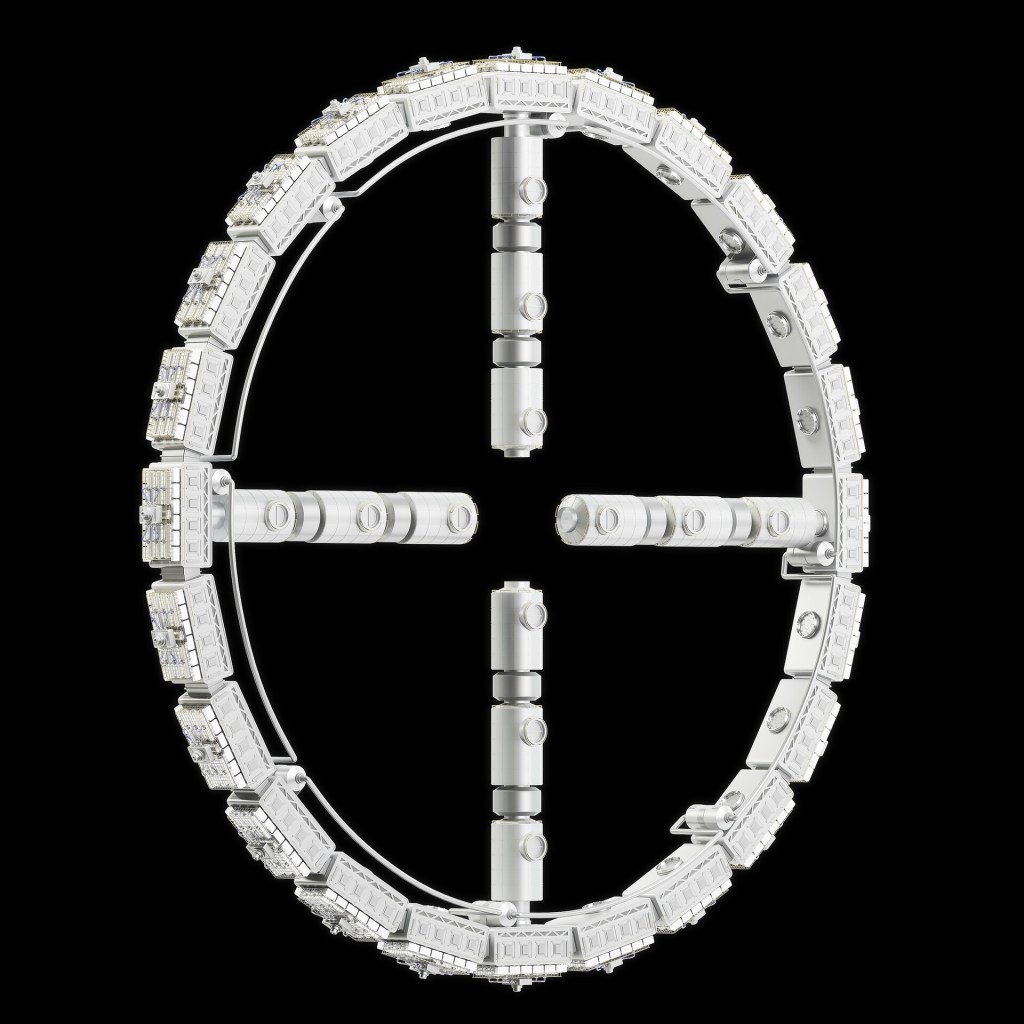
In order to spin smoothly the SSS would need to be balanced mass-wise. This balance could be simple for instance with a SSS with 2 or 3 arms built out and a large habitat or the end of each arm.
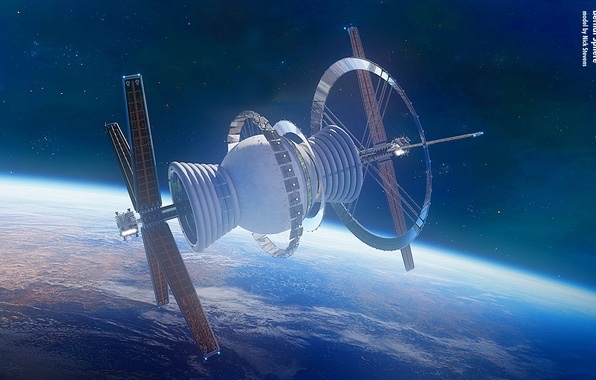
This would appear something like this.
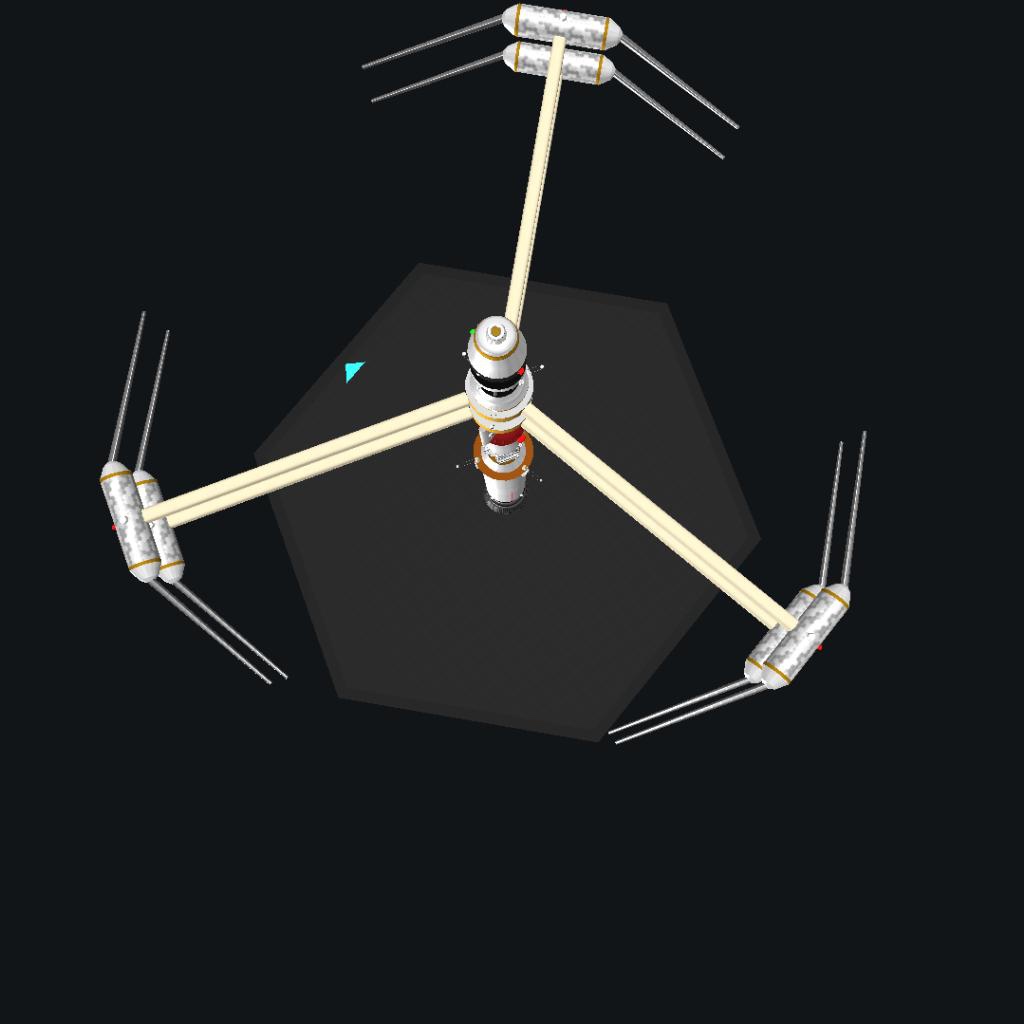
The habitats would be on a arms that could move the habitat in and out to balance it against the other habitats. Motors on the connecting rods with the center of the station would be able to make adjustments on the distance of the habitat from the center.
These connecting rods would also have elevators we could travel in to get to the habitats. Filling those tunnels with air and making them passable is probably impractical because it would add too much unusable space so it is more likely we would use something like an elevator concept to travel from the center where you would dock to the habitats.
Going from habitat to habitat could involve going to the center and then transferring and going to another elevator or it could be done by putting some kind of continuous elevator type structure that goes from habitat to habitat on the outside ring or even a separate ring some distance from the center that had a passage or elevator system.
The gravitation increases as you get father away from the center.
As we built more habitats they could be attached to each other at the edge or we could build separate arms for each. During times of serious construction of the station we would likely halt rotation and build so we didn’t have to deal with imbalances during construction.
Some people have imagined a liquid tank system of balancing a rotating space station. I believe that such a system has a lot of failure modes. Pumping water between tanks can be problematic as well as keeping them warm enough the water doesn’t freeze. The advantage of using water is of course you can use the water but not too much because you need it for balancing. Overall I don’t see that as very viable system and too dangerous. I also wonder about the water moving around because it is fungible or breaks in pumps or tubes.
So, I like the idea of using the stations own mass by moving the habitats themselves along the axis that are used for support and structural integrity. It would also give us flexibility to move the habitats to different altitudes to get different gravities and rotational speeds.
What does the Space Station have?
ENERGY
First, it needs an energy supply. I propose that a combination of nuclear reactors and solar panels be used. Nuclear is dense and reliable. Solar is reliable but has a lower lifetime. The size of the panels and weight are significant. Nuclear is more dense and efficient from a weight point of view.
Solar could be attached to the habitat modules and power could be distributed throughout the station. This would lead to a flower like configuration with the habitat modules on the inside and then large panels probably at least as large as the habitats flaring out producing a petal like effect.
This could be quite beautiful and practical way to get a large part of the energy.
If we used nuclear power we would likely want to move it away from the SSS by potentially kilometers to prevent any possible radiation issue. We could beam the energy back to the station via microwave. It is possible the solar power panels could be engineered to absorb the microwave radiation.
The power requirements of the station I believe would start at somewhere around 1Mw. The current ISS which is 1/20th size of the initial SSS uses 90Kw so a fair guess is 1Mw for the entire station.
A 500Kw nuclear reactor may be quite feasible. Remember that typical nuclear power stations are 1000 MW. So, this is 1/2000th the size of a Earth nuclear reactor. NASA is already experimenting with nuclear reactors that produce 100Kw that can be placed into space.
STORAGE
A large part of the space station may be reserved for storage of essentials, fuel for resupply, equipment spare parts etc.
A lot of this stuff could be put either as compartments close to the hub of the station or even kept like the nuclear reactor in some other facility adjacent to the SSS.
If it is combustible material like rocket fuel there would be a big advantage to storing a lot of that in large tanks kilometers from the SSS.
We might even build some kind of protective shield between the more dangerous elements like nuclear reactors, fuel or other compounds to shield the station from any accident.
We could support storage of a bunch of different fuel types for ION craft and other chemical systems but presumably we would want to minimize the number so we don’t have too many different fuels that aren’t compatible.
Storage of food and other perishable items might have to be kept at different temperatures but probably don’t care about gravity. They might be stored closer to the hub.
This is why in the design there is a large axial part of the SSS that is both docking stations and potentially storage or zero gravity experiment areas.
In some designs this might be relatively small but it should be quite expandable as we have requirements for zero gravity or storage of things that don’t care about gravity. Presumably a robotic system to deliver things from the storage units to the habitats and back would be engineered to make it easy to bring consumables up or return them.
Storage is important because one of the major missions of the SSS is as a depot stop for missions that go on from the SSS to Mars or other locations and so having a resupply station is critical to lowering the cost of missions and increasing functionality of those missions.
It is likely that eventually missions to Mars or other places will involve moving huge masses and that a more efficient reusable ION type propulsion system to deliver consumables such as fuel to be used for resupply or other materials on an emergency basis.
The SSS would represent another layer of response in case of failure or accident since the transit time from the SSS to the point of accident or repair would be significantly less. We could have higher speed craft that could make emergency trips to Mars in much shorter times using for instance nuclear propulsion.
Other Transportation vehicles
Another assumption in building a station is that once you have lifted yourself to 1000km from the Earth you don’t need as much delta V and more precisely you don’t need high specific velocity type fuel. From the SSS it is possible to launch ION powered craft or nuclear craft which have high endurance propulsion systems that don’t go fast quickly but over time are vastly more efficient.
A bulk of the mass to be delivered to Mars or other refueling missions and such could be staged using a nuclear or ION propulsion system that would take months longer but use vastly less consumable fuel or weight. Otherwise we will use a large part of the mass of the fuel we wish to depot to get it into position.
Since the missions can be planned years in advance we can spend a lot of time sending the materials to anyplace in the solar system with these vastly more efficient means.
The SSS could have a dozen or so of these other craft ready to be loaded up with equipment and experiments or missions and reused again dramatically reducing the cost to do things in space.
Another type of craft that is likely to be needed is some kind of short range utility vehicle for work around the space station. These could be used in construction and maintenance of the space station. An example of these kinds of vehicles would be:
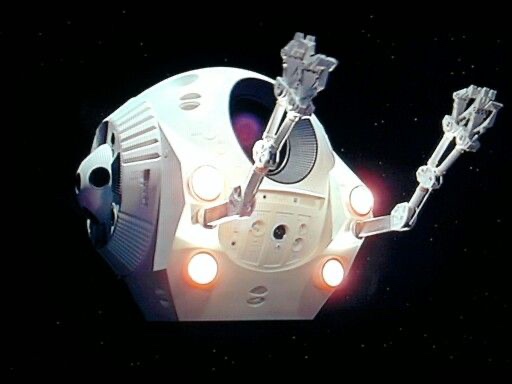
This craft was imagined in the movie 2001 : A space odyseey and it is remarkably prescient of the type of vehicle that would be needed in or around the space station instead of manned operations in space suits which are more dangerous and harder to set up and have limited duration. A craft like this with robotic arms could be incredibly useful.
Rotating spacecraft
As we start sending people to Mars we might want to think of building rotating habitats that are transported to the destination.
The longer the duration of the time to the destination the more damage people suffer without gravity. Therefore since we can build a rotating space station there is no reason we can’t build a rotating spaceship.
While such a ship wouldn’t travel in the atmosphere well in space the shape of the ship is irrelevant. So, we could build rotating structures around propulsion craft for human habitation.
Tourism
With a capacity of 100-500 people depending on the size of the station there is enormous potential to have hotels and tourism on the SSS. With the lower costs of the reusable vehicles both SpaceX and some other companies are developing the ISS might be an ideal tourism spot that lots of people would want to go to.
The SSS would need 20 or more people just to maintain and perform experiments and manage the operations of vehicles going in and out. So, there is plenty of room for people to visit or for rest between Earth and wherever else they are going.
Military Uses
Let’s leave this for another time.
 SpaceColonization
Leave a comment